AWS Announces Enhanced Custom Event Bus for Amazon EventBridge to Revolutionize Scalable Serverless Architectures

Organizations managing event-driven architectures at scale have long grappled with the operational friction inherent in multi-account environments. As enterprises increasingly adopt AWS best practices by isolating workloads into dedicated AWS accounts, the complexity of inter-account communication has surged. Historically, developers relied on a patchwork of cross-account rules and bus-to-bus configurations to facilitate event routing. While functional, this approach introduced significant overhead, obscured visibility for platform teams, and often led to ballooning costs as routing fees compounded across multiple bus instances. To address these systemic challenges, Amazon Web Services has unveiled a transformative enhancement to the Amazon EventBridge custom event bus, designed specifically to serve as a unified, centralized event backbone for large-scale organizations.
The Evolution of Event-Driven Infrastructure
The trajectory of serverless adoption has been marked by a transition from monolithic application structures to distributed, event-driven microservices. In the early stages, a single custom event bus in one account was sufficient for most teams. However, as the number of AWS accounts within an enterprise grew—often reaching hundreds or thousands—the "bus-per-account" strategy began to crumble under its own weight.
Platform teams, tasked with maintaining governance and security, struggled to track who was consuming specific event streams. Furthermore, the lack of native ordering guarantees forced developers to integrate secondary technologies like Amazon Simple Queue Service (SQS) or build custom logic to handle sequential processing. These workarounds not only increased the development burden but also created "architectural sprawl," where debugging a single event path could involve tracing across multiple disparate event buses and IAM permission sets.
Architecture and Functional Enhancements
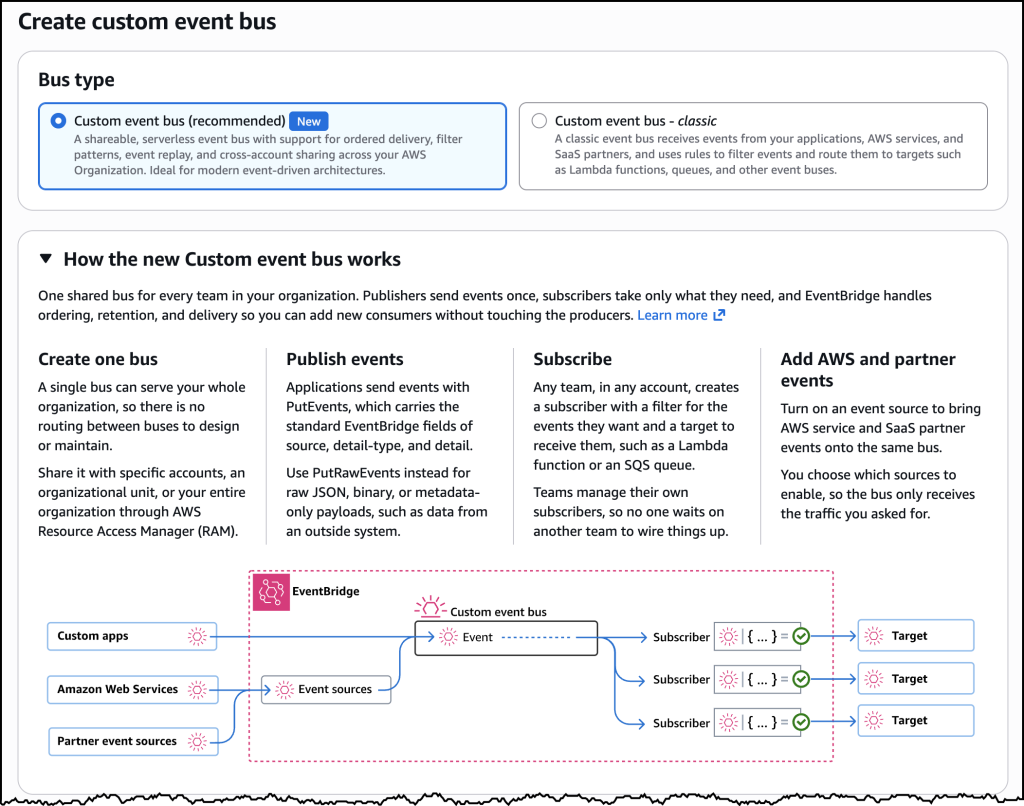
The new enhanced custom event bus represents a paradigm shift in how EventBridge manages high-volume, multi-account data flow. By allowing a single event bus to be shared across an entire AWS Organization, the new architecture eliminates the need for complex, manual routing configurations. The service leverages AWS Resource Access Manager (AWS RAM) to facilitate seamless sharing, ensuring that infrastructure teams can establish a centralized hub while allowing application teams to retain autonomy over their specific subscriptions.

A critical pillar of this release is the introduction of native event ordering. By utilizing an EventGroupId, publishers can now ensure that related events—such as sequential location updates in a logistics tracking system—are delivered in the correct order to subscribers. This is supported by a new synchronous invocation mode for targets like AWS Lambda, which confirms successful processing before acknowledging the event. This advancement effectively removes the requirement for intermediate buffering services, streamlining the developer experience and reducing the overall latency of the event chain.
Simplifying Subscription Management
The introduction of the "Subscriber" resource is perhaps the most significant change to the user interface and management workflow. Previously, a single event consumer required the configuration of separate rules, targets, and individual retry policies, often scattered across different AWS resources. The new Subscriber resource aggregates these components into a single, cohesive entity. This unified management layer includes:
- Integrated Filtering: Advanced pattern matching that allows consumers to subscribe only to the events relevant to their specific application context.
- Target Configuration: Direct assignment of downstream endpoints, whether they are Lambda functions, APIs, or other AWS services.
- Failure Handling: Centralized management of retry policies and dead-letter queue (DLQ) definitions, ensuring consistent reliability standards across the organization.
Furthermore, the new model supports JSONata expressions, enabling subscribers to transform event payloads in real-time. This allows teams to extract fields, rename attributes, or calculate new data points without requiring an intermediate processing step, effectively reducing the "glue code" often required in traditional serverless pipelines.
Economic Impact and Pricing Efficiency
Financial modeling in multi-account cloud environments has historically been difficult due to the compounding costs of cross-account routing. The previous per-event pricing structure, when applied across complex multi-bus architectures, often created "hidden" costs that were difficult to attribute to specific business units.
The new pricing model for the enhanced custom event bus introduces a more transparent ingress and egress throughput structure. Publishers are billed for the volume of events ingested, while subscribers are billed for the volume of events delivered. By consolidating the bus structure, organizations can significantly reduce the "routing tax" associated with moving events between multiple legacy buses. For large enterprises, this shift in the billing mechanism provides clearer visibility into cost allocation, enabling better alignment between infrastructure spending and specific organizational functions.

Industry Implications and Strategic Context
Industry analysts observe that this release positions EventBridge more aggressively as the primary message backbone for enterprise-grade serverless platforms. By providing a "centralized yet distributed" model, AWS is responding to the clear market demand for managed services that handle the "undifferentiated heavy lifting" of distributed systems.
"The industry has been trending toward more granular microservices, but the complexity of managing the ‘plumbing’ between those services has been a bottleneck," notes a lead infrastructure architect at a major financial services firm familiar with the beta rollout. "By offloading the ordering, routing, and deduplication logic to the event bus itself, AWS is allowing developers to focus on business logic rather than the underlying message transport infrastructure."
The move toward exactly-once delivery semantics—via content-based deduplication—also addresses a long-standing pain point. By hashing the payload and automatically discarding duplicates within a five-minute window, EventBridge provides a robust safeguard against network-level retries that could otherwise trigger duplicate processing in idempotent systems.
Rollout and Availability
The enhanced custom event bus is currently available in multiple AWS regions, including US East (N. Virginia, Ohio), US West (Oregon), Europe (Ireland, Frankfurt, Stockholm, Spain), and several Asia Pacific locations including Sydney, Tokyo, and Singapore.
Existing EventBridge users are not required to migrate; the legacy "Classic" bus remains fully supported for existing workloads. This phased approach allows organizations to adopt the enhanced bus for new projects or critical, high-scale services while maintaining stability for established, lower-complexity applications. Developers can initialize the new buses via the AWS Management Console, the AWS Command Line Interface (CLI), or through the EventBridge APIs, providing flexibility for Infrastructure-as-Code (IaC) workflows.
Looking Ahead
As the serverless ecosystem matures, the emphasis is shifting from merely "running code" to managing the complex interactions between distributed components. The enhanced custom event bus is a clear indicator that AWS intends to remain the dominant force in this space by providing high-level abstractions that handle the most difficult aspects of distributed systems, such as sequential consistency and cross-account governance.
For platform engineers and CTOs, the primary implication is a potential reduction in the number of custom-built, proprietary event-handling frameworks. By standardizing on the enhanced EventBridge bus, organizations can reduce their technical debt, improve the reliability of their event-driven applications, and achieve a more predictable cost structure as they scale their global footprint.
The integration of advanced features like JSONata transformations, content-based deduplication, and native ordering marks a sophisticated evolution of the EventBridge service. As adoption spreads, it is likely that this new model will become the default architecture for modern event-driven design, setting a new benchmark for performance and operational efficiency in the cloud-native era. The capability to handle 10,000 subscribers per bus, with the potential for further increases, underscores the intent to cater to the largest enterprises, ensuring that the platform remains performant even as the number of inter-team interactions grows exponentially.